Posts

That's A Wrap on the 2016 Beach Season

Image
On October 27th we officially wrapped up our 2016 season on the beach. We're still working on our final counts, but as of September 30th, we've interacted with 98,500 people this season both on and off the beach and hosted 52 educational programs on the beach. Now that's an epic season! HRAP Staff and Volunteers finished the season with an 'End of Season Cleaning and Storage Party' on the 28th. The HRAP trailer was emptied and the equipment cleaned and stowed for the winter. Planning for the 2017 Beach Season is already underway and we'll be back on the beach in February. We'll be revisiting the 2016 season on the blog this winter. Check back in with us to learn about the season from the perspective of the HRAP Interpreters.

Red Ascidian Tunicate - Aplidium solidum.

Image
Red Ascidians are tunicates, a marine invertebrate with a hard exterior layer, or tunic, where it get's it's name. The first known species of tunicate dates back to 485.4 millions years ago to the early Cambrian period, when most modern phyla first appeared.   The red ascidians have two siphons which move water in and out of it's body, much like a heart. They grow in colonies up to 20 centimeters long and can be a favorite food of the opalescent nudibranch. Have you seen a red ascidian at Haystack Rock? Let us know! Happy Tide-pooling!

Dendronotus Density Dispatch

Image
Tidepools on the north side of Haystack boasted a startling abundance of nudibranchs in the genus  Dendronotus . "Dendrites" is Greek for "treelike." Upon close examination, these creatures with branching bodies did appear treelike. Individual dendrontid against a background bryozoan. From a distance, however, the dendrontids looked like a dense growth of algae carpeting the floor of the pool.  The "blob" in the left-hand corner is a nudibranch "walking" upside down by moving its foot across the surface tension of the water. The mossy growths covering the sand are clusters of dendrontids in uncountable hundreds. Courtesy of Stephen Grace  

Until the next time we see them - Tufted Puffins

Image
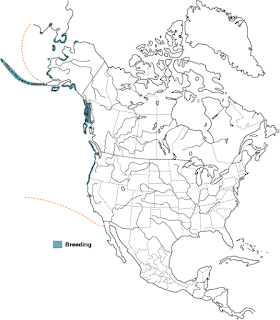
This summer, a U.S.F.W.S. volunteer closely monitored the iconic tufted puffins who call Haystack Rock their breeding ground home. The puffins use this space as their breeding ground, because they prefer to stay close to the ocean shore. Their survival is dependent upon the sea, where they catch the food that they eat and feed their young.    Puffins eat small fish and squid. They can hold several fish at a time in their large bill, which allows them to transport the fish back to their burrow to feed their chick. Recent studies on Atlantic puffins attribute the successful fledgling, and long term survival of chicks to an adequate food source. When fish populations decline, so do the puffin populations.   These puffins lay their egg 2-6 feet deep in a burrow. Near the top of Haystack Rock, on the grassy slope. The north side is shielded from the strong south winds. They dig out the soil with their large, shovel like bill, and lay one single ...
Image
A strange fish caused great excitement at the Rock this last week. A visitor came to the truck to say he'd "found a stingray." When one of our volunteers got to the tidepool, only the eyes in the photo were visible. The fish stayed buried in the sand with only its eyes exposed for about two hours as its pool shrank and warmed. An occasional puff of breath stirred the sand in front of its face. Many visitors stepped to the edge of the pool to stare at its eyes. When the tide came back in and refreshed the pool, the mystery fish finally rose from the sand. It swam around and then reburied itself. The mystery fish is oval, translucent, and this one is about two inches long. Can you guess what species it is?   Courtesy of Stephen Grace

Jelly Fish and an Octopus

Image
Video credit: Stephen Grace A few weeks ago, volunteers and staff found juvenile octopuses in the tide pools at Haystack Rock. You can see pictures of them in the last blog post . This past week, another juvenile octopus was found in a tide pool where the water was receding. The octopus was placed in an aquarium to await the incoming tide. Watch the video to see the octopus move around. Moon jelly Volunteers and staff are also seeing a number of jelly fish. Pictured above is a moon jelly, Aurelia aurita. The jellyfish is translucent, usually about 25–40 cm (10–16 in) in diameter, and can be recognized by its four horseshoe-shaped gonads, easily seen through the top of the bell. It feeds by collecting medusae, plankton, and mollusks with its tentacles, and bringing them into its body for digestion. ( Wikipedia ) Volunteer, Stephen Grace, also found this Pacific sea nettle jelly, Chrysaora fuscescens , about a mile north of Haystack Rock...

Interesting Sightings of the Week

Image
There have been some interesting sightings recently at Haystack Rock. Volunteers and staff have sighted juvenile octopuses, more nudibranch, a red rock crab, and a mottled sea star. Juvenile cephalopod spotted at Haystack Rock (Photo courtesy of Stephen Grace) While it's hard to tell exactly what type of cephalopod this is at this early stage, it's more than likely a Giant Pacific Octopus,  Enteroctopus dofleini. The Giant Pacific Octopus has a lifespan of three to five years, which is long-lived for an octopus.  Opalescent nudibranch among aggregating anemone Nudibranch continue to be seen. The opalescent nudibranch eat hydroids and anemone, which fight them off with their nemotocysts (stinging cells). Opalescent nudibranchs grow to about 3 in. and live less than a year.  Red rock crab When visiting Haystack Rock you may see a red rock crab, cancer productus . This crab uses its pincers to crush barnacles, which it eats. It also ea...