Posts

Happy Thursday - Some More Photos from Haystack Rock!

Image
A beautiful evening from the center of our sand area... We are so lucky to exist here! Last month, Lisa counted the Sea Stars during our Sea Star Survey Lisa working hard like always...  Haystack Rock illuminated in the morning light!

Spring, Sprang!

Image
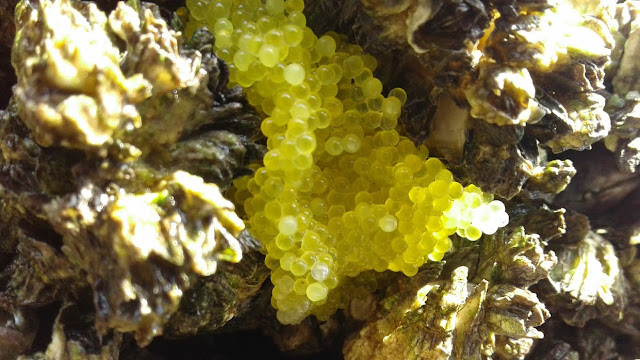
Spring has sprung at Haystack Rock and with it volunteer and staff Environmental Interpreters are finding loads of eggs and tiny juvenile recruits of different types. There have also been very interesting sightings of more precarious types that come with warmer weather; read our HRAP "nature notes" to learn more.... Tidepool Sculpin, Oligocottus maculosus , eggs  Bright yellow Tidepool Sculpin, Oligocottus maculosus , eggs can be found among the barnacles and mussels, often above the tide pools during low tide. Sculpin can vary in color from red-brown to green  and can grow up to 9cm long. Acorn Barnacle, Balanus glandula , recruits  Tiny, juvenile Acorn Barnacle recruits dot the intertidal like adorable polka dots. These animals have small, white volcano-like shells and are very common in the tide pools at Haystack Rock and elsewhere along the Oregon coast. Barnacle Nudibranchs, Onchidoris bilamellata , and eggs ...

Nudis, Hail, and Decoy Ducks

Image
What's new at the Rock these past few weeks? Glad you asked! Not only has the weather been completely and utterly unpredictable, but unique animals and marine debris have been making appearances. On March 1st, Environmental Interpreters, Gina and Kari, spotted opalescent and barnacle nudibranchs which can be seen in the pictures below. A Barnacle Nudibranch, Onchidoris Bilamellata , hiding in the center/left of the picture above, is among barnacles and anemones and has most likely just laid the egg mass seen in the upper left portion of the image. The beautiful Opalescent Nudibranch, Hermissenda Crassicornis , pictured above, was seen on March 8th as it relaxed in a tide pool, soaking in the calm morning low tide. Interpreters, throughout the past two weeks, saw HIGHLY variable weather patterns, causing high wind, surf, and surge warnings. In the image below, check out the hail covering the beach at Haystack Rock (and awesome staff a...

Watch Out Prey - They Sting!

Image
Alan Quimby was the lead interpreter on the beach on May 16, 2016 and spied an Aggregating Anemone ( Anthopleura elegantissima ) and a Shore Crab in close proximity in the tidepools. The aggregating anemone is an invertebrates that looks likes a flower, with a tube shaped body capped by tentacles. Colored anemones have algae living in their tissue in a symbiotic relationship. The anemone bends away or toward the light to facilitate the light level needed for photosynthesis in the algae; it return, the algae provides food to the anemone. Aggregating Anemone Anemones eat a wide variety of food, using stinging cells on their tentacles (called nematocysts) to paralyze their prey. They can even ingest small crabs and discard the shells. Perhaps that is what happened to the shore crab on this day as the crab must have gotten a little too close and appeared to have been paralyzed  by a small aggregating anemone. Paralyzed Shore Crab The anemone is abundant on the roc...

Haystack Rock Field Trips

Image
Haystack Rock is a great destination for field trips. The Haystack Rock Awareness Program provides educational field trip programs that integrate observation, investigation, and exploration. In 2016, HRAP hosted fifty-two educational programs on the beach for students of all ages, reaching over 2100 students. On June 10th, 2016, HRAP hosted a group of grade-school students. That day was rainy, windy, sunny - everything the Rock can be - but most importantly - educational! The students had a great time exploring the tidepools and learning about its inhabitants guided by HRAP interpreters. If you are interested in scheduling an educational group visit to Haystack Rock, visit http://www.ci.cannon-beach.or.us/hrap/page/teachers-planning-field-trip for details on scheduling a visit. The beach season will begin on February 13th and planning is already underway. We hope to see your group on the beach this season!

What is That Scurrying On the Sand?

August 8th was a cloudy day with a few sprinkles in the morning at Haystack Rock. Katie Corliss, lead interpreter, along with three additional interpreters were on the beach for the 1.5 ft low tide at 11:13 am. Over five hundred visitors experienced the Marine Garden during the five hours the interpreters were on the beach. Katie captured a great video of mole crab activity in the sand. In the genus Emerita  they are crustaceans commonly known as mole crabs, sand crabs or sand fleas. Related to hermit crabs and stone crabs, the mole crab spends much of its time buried in the sand. It is well camouflaged by its gray shell, burrowing quickly and frequently into the sand. The crab lives in the area of breaking waves, moving up and down the beach with the tides. It feeds by filtering tiny plankton from receding waves using a sweeping motion of an antenna. Check out the video of the crabs scurrying in the sand and burrowing in. Mole crabs are less that 2 inches in length an...

Opalescent Nudibranch In The Sand

Image
Today we look back to August 3rd on the beach. Gina Palmer was the lead interpreter on the beach for the 1.4 ft low tide at 7:46pm. It was a sunny afternoon with a NNW winds between 15 and 25 knots. The opalescent nudibranches, typically found under the boulders in the central pools of Haystack Rock, were today out in the sand. Opalescent Nudibranch  The opalescent nudibranch ( Hermissenda crassicornis ) is an invertebrate that resides in the intertidal rocky shores from Baja California to Alaska. They grow to about 3 inches, subsisting on a diet mainly of hydroids, but will also eat small sea anemones and bryozoans.  A nudibranch lives for a maximum of one year and is hermaphroditic. It's eggs are laid in narrow, coiled strings attached to eelgrass or algae.  The opalescents are a colorful species of nudibranch, having bright orange areas on their back with a blue line on each side. Next time you're in the intertidal zone at low tide - anywhere on t...