Posts

Showing posts with the label Black oystercatchers

Stewardship Report: Black Oystercatcher Success
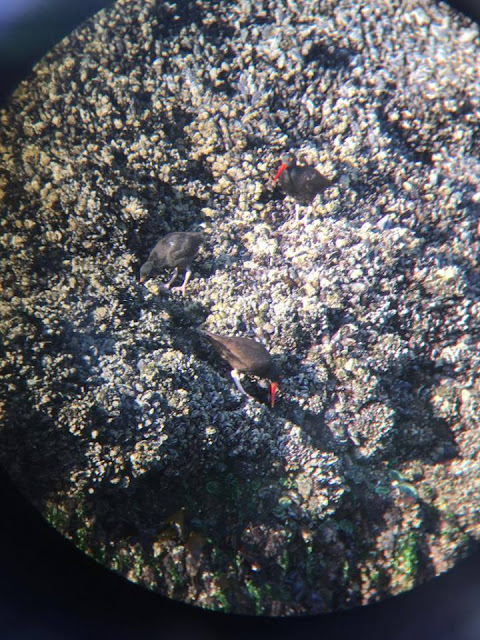
Image
As summer comes to an end, we at HRAP are reflecting on a busy summer and its challenges and rewards. One of the biggest rewards was seeing the resident Black Oystercatcher pair successfully raise a chick for the first time in six years! After losing their first nest in late May, they tried again with one egg. The chick hatched in late June, and it was a joy to watch the pair raise the chick in the nesting area until mid-August, when the chick fledged and started to forage around Haystack Rock under the watchful eyes of its parents. We are still seeing the trio foraging together on the boulders on the north and south sides, as well as along the north wall. The chick will stay with its parents until next spring, when it will head off into the world to try to find a mate. The Black Oystercatcher chick left the nest area with its parents around August 12. Here they are foraging on the north side (parents top and bottom, chick in the middle). Photo by Tia Prudholm The black oyster...

Stewardship Report: Shifting sands

Image
Sands built up significantly in Haystack Rock's tidepools during the spring, and now it's easier than ever to walk on sand while exploring, thereby avoiding stepping on tidepool animals that cover the rocks, such as barnacles and anemones. The seabirds are in the height of nesting season, so we are continuing to rope off nesting areas to prevent disturbance. Please help us help these birds by staying out of roped off areas. Lastly, the black oystercatchers are trying again: After losing their first nest, they are nesting again and we wish them success!  Substantial sand buildup allows easy exploration of the tidepools while avoiding stepping on rocks. Photo by Margaret Minnick Substantial sand buildup allows easy exploration of the tidepools while avoiding stepping on rocks. Photo by Margaret Minnick

Stewardship Report: Protecting nesting seabirds from disturbance during minus tides

Image
This week, there has been a series of morning minus tides at Haystack Rock. This opens up for exploration areas that are full of fascinating intertidal life, especially in the intertidal boulders to the south of Haystack Rock. At the same time, it exposes seabird nesting areas to increased human foot traffic. Human presence, especially where it isn't usually possible, can make birds nervous and they often leave their nests for a period as a result. If the eggs are left uncovered for too long or too often, they can get cold, causing the chicks inside to die. Areas are closed to protect nesting seabirds. Photo by Margaret Minnick This time of year is critical to nesting seabirds, most of which are seeing population declines. Disruption of their nesting habits can cause nest failure. That's why Haystack Rock Awareness Program staff and volunteers have been closing off areas around the rock during these morning low tides. Please be understanding of these closures when you v...

Stewardship Report: Black Oystercatchers are nesting!

Image
If you follow our newsletter, you know that the resident black oystercatcher pair at Haystack Rock is nesting! The nest is located in the loose rocky area just below the large "Do Not Enter" sign (see picture). This is the earliest they've nested in about a decade, and they currently have three eggs in their nest. The chicks are expected to hatch around June 4. A black oystercatcher sits on its nest at Haystack Rock. Photo by Margaret Minnick These birds are a U.S. Fish & Wildlife "Species of Concern," and have an average hatching rate of 29%. The chicks have only a 13% survival rate to fledging. So, every year the Haystack Rock Awareness Program works very hard to protect our black oystercatcher nest, so that they have the best chance of successfully hatching and fledging their offspring. To avoid any disturbance that might disrupt the nesting, HRAP staff are roping off the area in front of the nest during each low tide. When visiting the rock, be s...

Stewardship Report: Puffins Return, Along with Rough Weather

Image
If you’ve been following HRAP on Facebook and Instagram, you know that we first sighted puffins at Haystack Rock on April 3! Since then, the weather has often been challenging for puffin-spotting (and everything else!) with wind, rain, high surf, and surging waves. Nonetheless, we’ve seen 10-16 puffins on many days, and more on a few calmer days. Calm mornings at low tide are the best times to come down to try to spot them.   Other than puffins, our usual cast of bird characters – including murres, guillemots, cormorants, black oystercatchers, harlequin ducks, Canada geese, and bald eagles – has been a reliable presence. In the tidepools we’ve seen many opalescent nudibranchs, aggregating and moon glow anemones, a few ochre sea stars, and a leather sea star too. As the weather improves, there will be more opportunities to see the amazing wildlife that lives, feeds, nests, and hunts at Haystack Rock. We are looking forward to it and hope you'll come to visit! ...

Stewardship Report: Plenty of Action for Birdwatchers

Image
There has been plenty for birdwatchers to see at Haystack Rock this week, including three kinds of ducks! In addition to harlequin ducks, which are frequent visitors, HRAP Naturalists have spotted mergansers and surf scoters in the past few days. Common murres also made an appearance again, with approximately 1,000 visiting the rock late last week. Bald eagle and peregrine falcon visits are a near daily occurrence. An eagle took a common murre last Friday, only to have a falcon try to steal it! – but the eagle prevailed. The less-dramatic, but much cuter, black oystercatcher pair has been seen every few days feeding in the tidepools during low tide. Surf scoter   Harlequin duck

Stewardship Report: First Sightings of the Season

Image
Our first week of HRAP's beach season brought rain and cold temperatures, but also a few clear days and some exciting wildlife sightings. We saw about 100 common murres on Haystack Rock and another 60 on the north Needle at the beginning of the week, only to have them disappear after a couple of days. This is actually not particularly unusual – last February, murres came to the rock for a few days and then returned in April, and those with longer memories say this pattern has happened several times over the years. We’ve also sighted our resident black oystercatcher pair on the north and south boulders, a handful of harlequin ducks in the calm water near the boulders, and a peregrine falcon, a bald eagle, and a pair of Canada geese at the top of the rock. This past week, low tides allowed us to get out to the tide pools for the first time this beach season. Winter storms swept away much of the sand, leaving large areas of bare rock that provide good access from the sou...

BIG NEWS!!!!

Image
BIG NEWS! Guess what? Guess what? THE BLACK OYSTERCATCHERS HAVE BABIES!!!! THREE OF THEM!!!!!! AND THEY SURVIVED THEIR FIRST WEEK OF LIFE!!!!     We are REALLY excited about the little fellas. It has been a week and a half of a lot of excitement and a little added stress. We are working hard to ensure that the parents are happy and that the babies are protected. Please help us do that by understanding why there might be more area closed off than normal. Black Oystercatchers are extremely special birds and we are lucky to have a pair that nests at the Rock. Ready for the quick and dirty story of Black Oystercatchers: They are shore birds who are considered a species of concern because their population is so low. It is estimated that there is only 400 on the entire coastline of Oregon, approximately one for every mile. They are territorial and will loudly chase off any other Oystercatcher that comes to close. At the Rock, there has been a pair nesting for a whi...